The twelve tone system by Arnold Schoenberg is based on series, in wich
all twelve tones are equal. A serie contains all twelve tones in a random
sequence. Series can be mirrored, can be played backwards (retrograde)
and the mirroring can be played backwards (mirroring of the retrograde).
In the musical setting of the poem "Don’t let the snow fall" by James Purdy,
I made a combination of series and the tone clock. I chose to use the second
hour of the tone clock because of it's cold, icy character, which is what
the poem is about: the coldness of the winter symbolises the cooling off
of a relationship. From the second hour I derived the following series:

The bass preludes with this series solo, and in the repetition, the
horns play transpositions of this sequence on top of the bass, thus playing
a minor-major seven chords that moves in parallells through the twelve-tone
landscape::

The melody of the refrain is based on the same series. By adding notes
to the basic triads of the second hour, I created jazz harmonies:

Don't let the snow fall or the sun give up it's flame 
keep his heart from free- zing in the bit-ter sting of the grave. |
In the verse, the second hour harmonies are steered by the eighth hour.
This results in the same triads as in the opening melody of the bass, only
the sequence is altered:

To prevent the triads, consisting of whole tones and semitones, from
sounding as clusters, I chose for a more wide spread positioning of the
harmonies. By deriving roots from the triads I created minor-9 and major-7/9
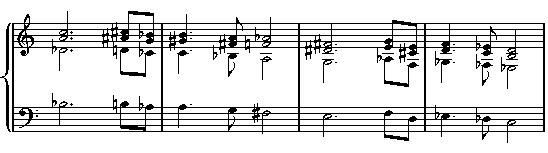
chords, thus creating a jazzy sound. To support the 12 tone series in the
melody, I had to apply sixth hour steering on the second level, which resulted
in these series of second hour harmonies:
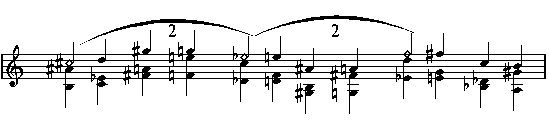
and arranged, it looks as follows:
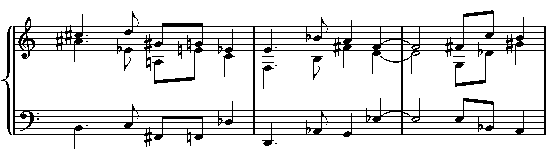
And after that I applied the retrograde of the mirroring, transposed
by a minor third:
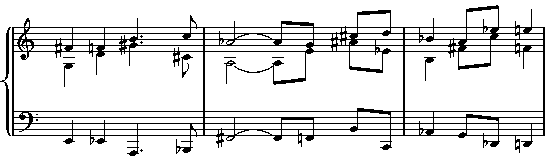
Mirroring the series means reversing the direction of the intervals,
and this also applies for the harmonies and the steering:

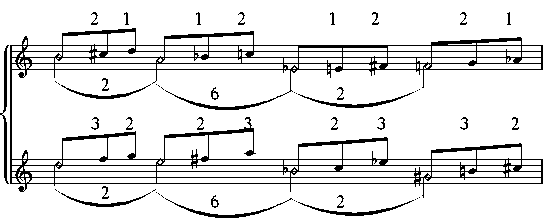
A little later in the composition the mirroring appears, and I added
triads of the seventh hour, steered also by the eighth hour, thus creating
dominant seven chords with flat fives and sharp nines:
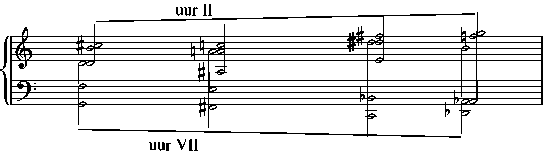
By deriving the roots from the chords and using them as bass notes,
the following harmonies appear:
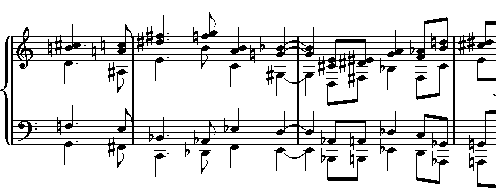
I chose for these harmonies to give extra support to the sentence "I
chide the hail for falling", and the combination of these two hours creates
very strong jazz harmonies, building tension towards the refrain:
In the verse I created space for a free bass solo, based on the second
hour triads of the bass-introduction.

