pièce en forme de poire
In classical music, compositions always have a form. For instance: song
form, sonata form or rondo. Eric Satie used to write his compositions without
any form at all. When someone mentioned this, Satie (in 1903) decided to
write a piece with a form, and called it 'Trois morceaux en forme de poire'
(three pieces in the form of a pear). The notes in the score for a fact,
formed the shape of a pear.
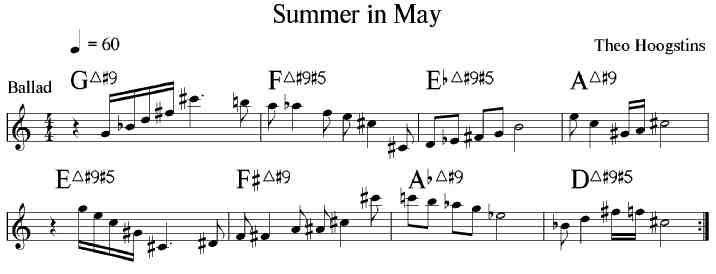
In the very hot month of may in 1998, I wrote the composition 'summer
in may' with a score in the same shape. This is caused by the fact, that
the first four bars are mirrored in the next four:
The composition is based on the third hour of the tone clock. By putting
the triads on top of each other, the following harmonies come into being:
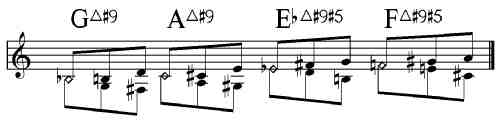
Five note chords consisting of semitones and minor thirds come into
being.
The composition is written linear, which means that the melody is more
important then the harmony. Linear is derived from 'line', and the important
lines are the lead and the bass.
A scale has come into being, consisting of semitones and minor thirds,
leaving one major third. This major third can be divided in the same way
by a semitone and a minor third.
Another way of approaching this, is Nicolas Slonimsky's method in the
book "Thesaurus of scales and melodic patterns". Slonimsky divides the
octave into equal parts, and within the created intervals he makes another
division. For instance, dividing the octave in four equal parts creates
a diminished tetrad (four minor thirds on top of each other). By dividing
each of these minor thirds into a whole tone and a semitone, he creates
a octotonic scale.
In Summer in may I divided the octave in three equal parts, resulting
in three major thirds on top of each other. Within these major thirds I
made a division of a semitone and a minor third.
In the first chord (Gmaj7+5)
this results in the following scale:

The major thirds are represented by open notes; clearly can be seen
how they divide the octave in three equal parts. The closed notes divide
the major thirds into a semitone and a minor third. This results in a scale
that sounds related to the gipsy scale, the blues and the octotonic scale.
Essential is to play this scale in the improvisation, thus creating a color
that is consistent with the composed part.

