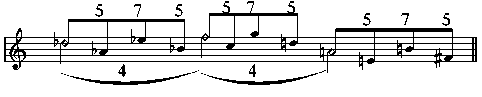
To show how I derive tetrads from the tone clock triads and how steering on more levels can be achieved, I will show how I created the harmonic structure of "Ode to Walt Whitman", based on a poem by Garcia Lorca.
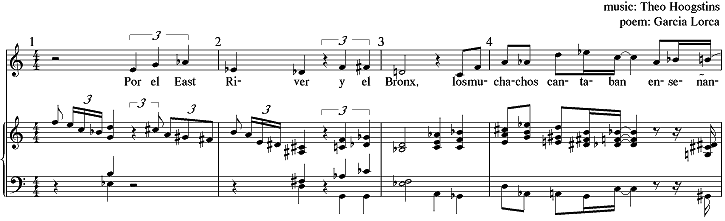 |

These chords I used in the first group of six chords. For the second group I made another distribution and then changed the steering:

This gave the following result:
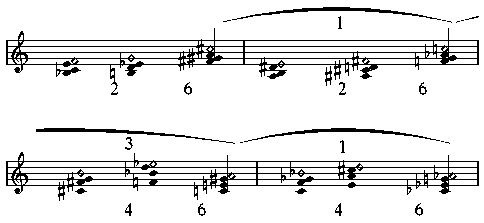
The tetrads ate steered by the eighth hour. On the second level the groups of three tetrads are steered through the twelve tone field by the third hour. I continued this steering for two more groups (1-3-1-3-1) resulting in six groups of three tetrads.
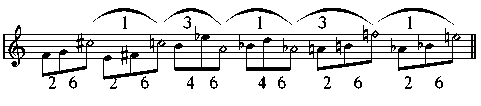
Now I have two triads of the third hour on the second level. Then we steer these groups again through the twelve tone field by the ninth hour, thus adding the six remaining complementary triads of the third hour to the second level steering:
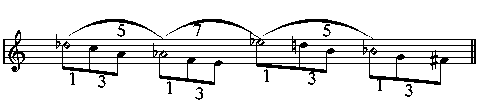
The steering on the third level is a symmetrical tetrad of the seventh hour, so the next step is to steer this tetrad on the fourth level through the twelve tone field by the twelfth hour.