 In
the past jazz has always been an artform in which musicians were invariably
looking for new musical ideas. The evolution of composing and improvising
has been the most important ingredient in which jazz could develope into
the most diverse musicform. Think for instance of player/composers like
Charlie Parker, Charles Mingus, John Coltrane, Miles Davis and Ornette
Coleman. As the end of the century comes closer musicians start reaching
back more and more to the music of the past, and jazz turns into a kind
of museum music in which the art of reproduction becomes more important
then the art of creation. Very few musicians of our time are still looking
for new ideas and angles to help jazz enter a new century of possibilities.
Classical music has been developing over the last few ages, for instance
through Arnold Schönberg in the beginning
of this century. When he introduced the twelve tone system, a whole host
of possibilities was added to music. What Schönberg
did not provide was a satisfying solution for harmony in this new tone
system. Untill then harmony had been based on the "Traité de l'harmony"
by Jean Philippe Rameau from 1722, based on the diatonic scale. This system
is based on three chords taken from this scale: tonic, dominant and subdominant,
and their relation to each other. This simple and very basic hierarchy
of tones, has been the basis on which classical music could develope. But
when Schönberg introduced the twelve
tone system, based on the chromatic scale, the diatonic harmony system
was not relevant anymore. Composers throughout the whole century have been
looking for a solution to this problem, and it was Peter Schat who came
up with an inventory of possible triads in the chromatic scale, which he
concieved to connect to the time points or time markers of the clock, thus
giving a possibility of reference and comunication to ideas of tonality
in the chromatic scale.
In
the past jazz has always been an artform in which musicians were invariably
looking for new musical ideas. The evolution of composing and improvising
has been the most important ingredient in which jazz could develope into
the most diverse musicform. Think for instance of player/composers like
Charlie Parker, Charles Mingus, John Coltrane, Miles Davis and Ornette
Coleman. As the end of the century comes closer musicians start reaching
back more and more to the music of the past, and jazz turns into a kind
of museum music in which the art of reproduction becomes more important
then the art of creation. Very few musicians of our time are still looking
for new ideas and angles to help jazz enter a new century of possibilities.
Classical music has been developing over the last few ages, for instance
through Arnold Schönberg in the beginning
of this century. When he introduced the twelve tone system, a whole host
of possibilities was added to music. What Schönberg
did not provide was a satisfying solution for harmony in this new tone
system. Untill then harmony had been based on the "Traité de l'harmony"
by Jean Philippe Rameau from 1722, based on the diatonic scale. This system
is based on three chords taken from this scale: tonic, dominant and subdominant,
and their relation to each other. This simple and very basic hierarchy
of tones, has been the basis on which classical music could develope. But
when Schönberg introduced the twelve
tone system, based on the chromatic scale, the diatonic harmony system
was not relevant anymore. Composers throughout the whole century have been
looking for a solution to this problem, and it was Peter Schat who came
up with an inventory of possible triads in the chromatic scale, which he
concieved to connect to the time points or time markers of the clock, thus
giving a possibility of reference and comunication to ideas of tonality
in the chromatic scale.
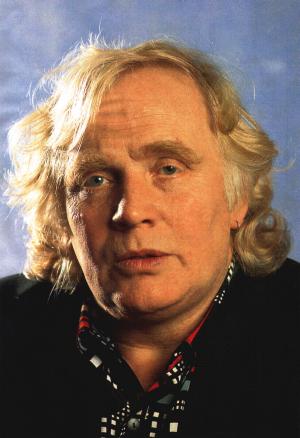
photo: Peter Schat.

