Before being able to explain the tone clock we have to set a few rules:
- When we speak of triads, we mean a combination of three intervals,
- Such a triad is built on the smallest interval.
- The intervals all have a number, wich is the numberof semitones between the two notes. For instance: 1 is a semitone, 2 is a whole tone and so forth.
1-1-10, 1-2-9, 1-3-8, 1-4-7, 1-5-6.......1-6-5 ?
The last one is allready mentioned in a different order, so we have to continue with the next new combination, wich is:
2-2-8, 2-3-7, 2-4-6, 2-5-5, 3-3-6, 3-4-5, 4-4-4.
Exactly twelve triads appear and they are placed on the twelve hours of a clock in the above mentioned order. The triads are placed in a module which is also based on a clock, only now the hours are replaced by the twelve notes:
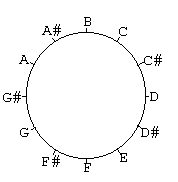
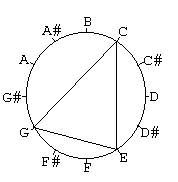
If we draw the triad C-E-G in the module the following triangle appears:
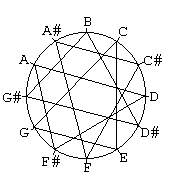
and in the following module we see that this combination
of intervals fits three times in the module: two major triads and two minor
triads. This figure we find on the eleventh hour of the tone clock.
 All
the other combinations mentioned above, fit in the module four times except
the diminished triad, wich is displayed as a tetrad, fitting three times
in the module. Combining all the modules with their four complementary
triads on the face of a clock results in the tone clock. The triads of
every hour are steered through the twelve-tone- field by one or more hours
as is shown in the next chapter.
All
the other combinations mentioned above, fit in the module four times except
the diminished triad, wich is displayed as a tetrad, fitting three times
in the module. Combining all the modules with their four complementary
triads on the face of a clock results in the tone clock. The triads of
every hour are steered through the twelve-tone- field by one or more hours
as is shown in the next chapter.

