Peter
Schat's Tone Clock in jazz and improvised music, by Theo Hoogstins.
chapter 4
Harmonies
Due to the fact that every hour contains only
its own intervals, the complementary triads and tetrads sound very consistent
in combination with each other. Every hour represents its own color, and
the complete instrument of the tone clock provides a palette of twelve
different harmonic colors.
Melodies and twelve tone sequences are very well
supported by these harmonies, and although there is no recognizable tone
center, a very transparent openness can be derived from this way of composing.
An example of this is the composition "La Riviere Souterraine", which is
an impression on an underground river in France.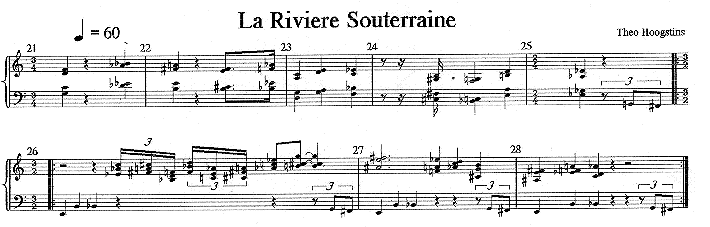
It starts of with
a lonely trumpet, reflecting the silence, and grows in volume and orchestration
to an explosion of sound, of which the echo's repeatedly come back. The
echo's slowly die and the silence returns in the cave. Analyzing this composition
with the tone clock, we see in bar 26 a bass figure in Eminor
and the horns play the three complementary chords from the eleventh hour:
Aflat minor F#minor
Bflatmajor
Then a series of eight complementary triads from
the eighth hour follows. In bar 21 till 26 the melody is a twelve tone
sequence, harmonized with tetrads of the seventh hour. Three of these tetrads
are also complementary and placed in the module look like this: 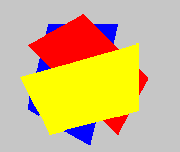
To see by which hour these tetrads are steered,
we first have to put the chords all in the same position.
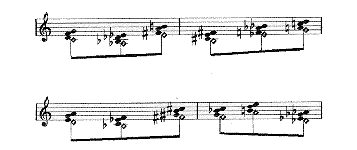
We now see that these tetrads are steered by the
twelfth hour, the open notes demonstrate the movement of the chords. All
of the four triads of the twelfth hour are represented in this steering.
If we look at the first note of every one of these triads and put them
in a sequence we get the steering on the "second level", which is the steering
of the steering groups. These notes are: C-B-D-F.
We saw earlier that the twelfth hour was only steered by the first hour.
It can however be steered by other hours, but this always results in the
same four triads. If we change the last note in this sequence into the
closest one, we get C-B-D-Dflat,
which is the BACH motive transposed with a whole tone. In "La Riviere Souterraine"
I have chosen for free improvisation, with this restriction that the musicians
get the instruction to use the composed material as basis for the improvisation,
which leads to very surprising results, especially in the piano solo by
Jan Jongbloed on the CD "Ear Opener". It is also possible to improvise
on harmonic structures, derived from the tone clock. To obtain a jazzy
sound, I like to use tetrads instead of triads, so it is necessary to translate
the tone clock into jazz harmonies. To obtain this I developed a system
comparable to Ornette Coleman's Harmolodics. The basic idea behind this
is that three complementary tetrads also create a complete twelve tone
structure. I found a lot of combinations, which can be derived from different
hours. A few examples:
Derived from the eleventh hour:

Derived from the twelfth hour:

Derived from the sixth hour:

The Phare of Biarritz is a tune in which I
used the twelfth hour tetrads:
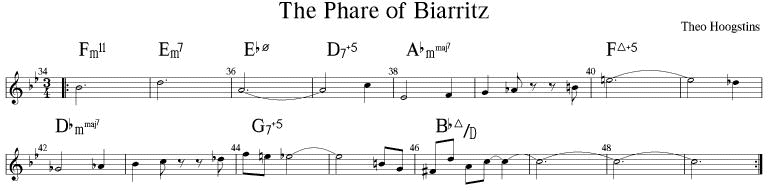
And in the next example, the twelfth hour triads are extracted from
the tetrads:

The twelfth hour variation can also be
heard in the alto solo and the bass solo in "2soon2die"; the eleventh hour
variation in the bass solo on "Onweer", and the C-melody sax solo in the
same composition is based on the sixth hour variation. Both tunes can be
found on the CD "Ear Opener" by the Theo Hoogstins Octet.


